Tuesday, 31 July 2012

Wet, wet, wet!

The residents of Medellín frequently speak of how the quality of life in their city has improved drastically over the past decade. After Medellín-native Alberto Uribe became Colombia’s president in 2002, the Paisas, or residents of Medellín, began to see a striking change in their city, as the federal government focused more attention on Colombia’s second city. Infrastructure was improved, public transport was upgraded, and safety concerns were tackled head on. Most strikingly, many of the social problems that had plagued the city began to be addressed through a citywide cultural revolution.

One of the most notable initiatives was the creation of a Sports and Recreation Institute, INDER, an organization that encourages young people to engage in physical activity and play sports. Across the city you can see numerous public soccer fields, basketball courts, swimming pools, playgrounds and youth recreation centres. Medellín hosts over seventy such facilities, completely free and open to everyone, from foreign tourists to children from poor neighborhoods. 


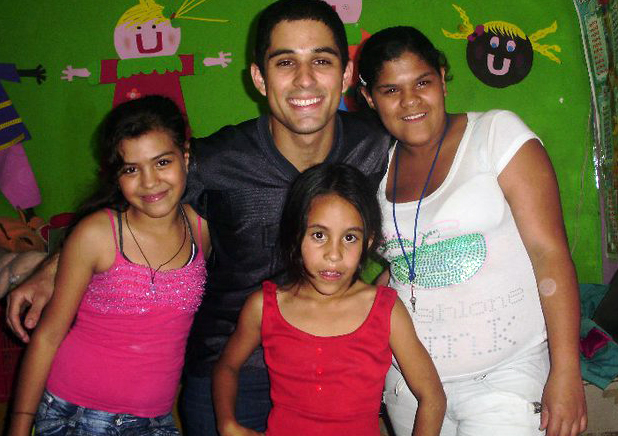
Recently the children from one of Globalteer Volunteer Colombia Children’s projects were treated to an afternoon excursion to a nearby pool by new volunteer Alex and visiting ex-volunteer Michael. Equally thrilled to be welcoming Michael back to the project after several months away from Medellín, as well as from the excitement of showing Alex their neighborhood, the children eagerly took turns grabbing the hands of the two foreigners and leading them along as the group of twenty-five paraded through the bustling hillside community. 


The INDER swimming pool is only a ten minute walk from the project, but for many of the children it was their first visit. As it is a public pool and the Paisas take personal hygiene very seriously, everyone was obliged to come prepared to swim with tight-fitting swimming suits and caps. While the other adults changed into their Speedos, a few of the children chose a bright lime green swimming cap for Michael from the vendor outside the pool. 


The complex is small but state-of-the-art, boasting a small children’s pool and a much larger one for adults. Several INDER employees stood watch, clad in the organization’s easily recognizable yellow and green outfits, and led the twenty small children (and the foreign volunteers) in various aquatic activities. 


Unfortunately, two of the young boys had forgotten to bring a tight-fitting swim suit, so were not allowed to enter the pool. Forced to remain in the small plaza between the two pools in their baggy shorts, they looked longingly through the chain-linked fence at the other kids playing in the pool. All of a sudden powerful jets of water erupted from hidden spouts in the plaza, soaking the two surprised boys. The other children quickly abandoned the pool to join them, running around the plaza enjoying the impromptu shower, and often sitting directly on top of the jets. Various children placed their swimming caps on top of the strong jets of water and squealed with joy as their caps shot high up into the air. 


After several hours playing in the water the children were worn out, and several were even able to trick the volunteers into carrying them part of the way back to the project. The group collectively decided to stop at a corner restaurant on the way back and the twenty children, two staff members, two volunteers, and volunteer coordinator all shared a large meal of chicken and Coca-Cola. The irony of the food choice was not lost on the children, as they had all taken to affectionately calling Michael “chicken” during his six-month stint as a volunteer. Obviously thinking it hilarious to be eating chicken with the man who had so successfully taught them the word in English that they had decided that it should be his nickname, many of the children insisted on having their picture taken with both Michael and a drumstick or chicken breast.


During what was to be the first of numerous future visits to the neighborhood pool, the children were reminded by their adult chaperones of how lucky they were to have such impressive recreational facilities so easily accessible for everyone to use. The city’s initiative stemmed from the belief that by providing the city’s youth with unrestricted and plentiful access to recreational opportunities and by promoting sports and wholesome activities for them to become engaged in, the young people would be far less likely to fall victim to many of the temptations, vices, and dangers that have been known to plague the city’s marginalized hillside barrios. By all accounts the INDER initiative seems to be a huge success.  

Thursday, 5 July 2012

The magic of Medellín


There is something magical about Medellín. Maybe it’s the perfect weather, maybe it’s the beautiful setting, or perhaps it’s the friendly people. Whatever it is, it keeps drawing people back to visit and even to live here.

Long-term Danish volunteer Michael is on his way back to Medellín right now. He came to Medellín for a three-month volunteer stint in November 2011 but found it so difficult to leave that he ended up staying a total of six months! You can read more about ‘the volunteer that wouldn’t go home’ on our Globalteer website

In his old life, Michael was head of an anti-corruption initiative at the World Economic Forum in Geneva but volunteering in Medellín changed his life and he now plans to start his own organization to help impoverished children. We wish him the very best of luck!

Michael and some of the kids at one of our partner projects


Australian volunteer Jodie volunteered with Globalteer at one of our Colombia Children’s Projects in August 2011. She came back to the flower-filled ‘City of Eternal Spring’ a few months back and is now planning on making the city her home.

Kevin was one of our Globalteer
 Colombia Children’s Project volunteers in May 2011. He had such a great experience that he recently returned to Medellín with a friend for a 10-day visit. Kevin was keen to see the wonderful kids he had worked with during his volunteer stint and loved catching up with them all again at one of our Globalteer Colombia Children’s ProjectsKevin is planning on moving to Medellin next year and is committed to helping more and raising funds for the projects here.


Californian Bob holds the record for returning volunteers - he has volunteered at one of our Globalteer Colombia Children’s Projects three times! He continues to make donations to help support our projects and he will be coming back to visit ‘his kids’ at the end of the summer.
Bob and friends


And recent volunteer, Norwegian Bjarne, had such a great experience in Medellín that he is also planning on coming to live here in 2013.
Bjarne on an outing with some of the cute Colombian kids


Lukas, who came from Holland to volunteer for 8 weeks from October to December 2011, also had a life-changing experience in Medellín. He recently went back home after staying and living here for 8 months but he didn’t go alone. He met a local Colombia girl, fell in love, and has taken her back to live in Holland where they are planning on getting married very soon. Congratulations, Lukas!

Lukas on an outing with some of the kids


It’s amazing and very special to us that many of our Globalteer volunteers have enjoyed both their experience at our projects and their stay in Medellín so much that they have either stayed much longer than originally planned or have found a way to come back to visit or live! 


Thursday, 21 June 2012

Barefoot in the park

When listing the various reasons why they love Medellín and have either continued to return or stayed longer than planned, many foreigners routinely mention the perfect weather, great public transportation system, gorgeous natural setting, and friendly and open people. Another pleasant surprise is the numerous public holidays that Colombia enjoys. 

With 18 days, Colombia ranks first in the world for its number of public holidays. These are taken so seriously that officially, if a holiday does not naturally fall on a Monday, the day off is moved to a Monday so everyone can enjoy a three day weekend (called puentes, or bridges). The holidays are so numerous that most Colombians have no idea what the occasion is and, when asked why everyone is celebrating, most locals will reply with blank stares or answer with a shrug “it’s something religious” or “because it’s Monday”. 

At one of Globalteer’s Volunteer Colombia children's projects, most of the seventy-odd children go home to spend time with their parents on puentes, but not all the children have parents or homes to go to. On these occasions as many as ten children of various ages remain at the project, occupying themselves by playing games, watching TV, or revising their schoolwork. Though there are several nearby parks the children can only go to these when accompanied by an adult, a rule demonstrated by the constant cries of “tio, vamos al parque” whenever a volunteer arrives for the day.


Recently, when Globalteer Colombia’s latest volunteer, Bjarne Aakeroe from Norway, began his placement at one of Globalteer’s Volunteer Colombia children's projects, his first day coincided with one of these puentes. When Bjarne and Globalteer’s volunteer coordinator John arrived at the project, it was unusually quiet for a residential foundation normally filled with noise and activity. While several of the older kids busied themselves doing teenage things upstairs in their rooms, the five smallest remaining boys hovered over their collection of trading cards in the main lobby. 

Delighted to welcome a new visitor to the foundation, six-year-olds Mario, Carlo, David, Paulo and Alejandro* quickly took Bjarne by the hand and led him on a personalized tour of their home, visiting the separate dormitories, the library, the computer room and the classroom. The children were rewarded for being such good tour guides by a visit to the nearby court and with palos locos (crazy sticks), their favorite popsicle from the corner shop. Bursting with energy, they ran wildly around the court while licking their treats and shouting that their crazy sticks make them crazy! 


John and Bjarne then decided that such a particularly beautiful day called for a trip to the nearby Parque de los Pies Descalzos, or Barefoot Park. An expansive complex filled with restaurants, an interactive science museum, an urban bamboo forest, a large sandbox-like area where shoes are not allowed, shallow pools for splashing your feet, and hidden fountains which shoot jets of water out of the ground, the park was a gift to the city by the adjacent Empresas Publicas Medellín, one of Colombia’s largest power supply companies. At the taxi driver’s urging, the five young boys scrambled in to the backseat of a taxi along with the squashed volunteer coordinator, while the larger Scandinavian volunteer got to stretch his legs in the front seat. The taxi driver appeared bewildered to hear the two foreigners addressed by all the children as tio, or uncle, and asked how many nephews they had!


Barefoot Park was filled with families, ice cream vendors, picnicking couples, helpful park guides, and numerous wet children running through the random jets of water that erupt from the ground. The five lucky boys immediately shed most of their clothes and ran to the sandbox where they took turns burying each other under sand and gravel.


Emerging smiling but completely filthy, they then ran to join the other children in the jets of water to wash off. Before long most of the boys had exhausted all the energy obtained from los palos locos, and were found stretched out on the pavement in the middle of the plaza, suntanning and drying off as if they were at the beach. Only Mario* remained at the fountain, sitting cross-legged directly on top of a dormant spout, patiently awaiting the next round of water with a large toothless smile on his face.

At the conclusion of an unusual first day of volunteering, the Norwegian remarked to the volunteer coordinator, “I think I’m going to like it here”.  


(* The children's names have been changed to protect their privacy.)

Wednesday, 13 June 2012

Celebrating Mother’s Day


The weather in Medellín is considered by many to be perfect. With clear blue skies, bright mid-day sun, light breezes which come down from the mountains that surround the city, and temperatures that consistently hover around 22 degrees Celsius, Medellín truly lives up to its nickname “The City of Eternal Spring”. 

The Paisas – as the locals call themselves – thrive in these conditions. The year-round springtime temperatures put a spring into their steps and a smile on their faces, and nobody misses an opportunity to enjoy the beautiful mountainous countryside that is easily accessible from the city in every direction. 

To celebrate Mother’s Day and to take advantage of a particularly beautiful day in late May, the staff at one of  Globalteer Volunteer Colombia’s partner projects partner projects organised a large excursion for the project’s approximately 60 children and their parents. Piling into two large rented buses at the project in a largely industrial part of downtown Medellín, the children, parents, and project staff were all set to enjoy a long day out in the countryside. 

A 30-minute bus ride took the group to Copacabana, a small municipality north of Medellín. Their destination was a nature park called La Quebrada Piedras Blancas. As the park is well off the main road, the buses deposited their passengers as close as possible to the park and everyone walked the remaining 15 minutes up a cobblestone street. Everyone helped carry something from the buses to the park – parents with arms full of firewood, foundation staff with food and large pots, small children with three-litre bottles of Coca-Cola, older children carrying the smallest children on their shoulders.


The lush park occupies a small valley, with green spaces hugging the hillsides and a small river flowing through the middle of the park. Water cascades down rocks in the river, forming small waterfalls that the children jumped under immediately after arriving. Bottles of Coca-Cola were placed in shallow water to keep them cool for the day, and children and adults alike stripped down to their bathing suits to splash and play sports in the river. 


While a soccer game was organised between children and parents, one of the more resourceful fathers quickly set to making a fire, and the foundation staff got to work peeling vegetables and making other preparations for the stew, a regional favourite called sancocho. Heavily meat-based, as the Paisas are generally very carnivorous, sancocho is a thick stew of beef and pork, with potatoes, carrots, yucca, and corn. Before long two pots, each large enough to fit a small child, were placed over the fireplace and filled with the bubbling stew, and everyone stopped all other activities to form a long line and await generous portions. 

The children sat with their parents to eat lunch and regain their spent energy, but before long they returned to play in the water with much sancocho-fuelled vigour. 


The rest of the afternoon was spent playing games, enjoying the calm respite from the activity of the city, and relaxing and chatting under the shady trees. As the sun began to set at 6pm everything was packed up, the pots were cleaned in the river by some of the older kids, wet and shivering children were clothed by their parents, and everyone began to make their way back to the buses with huge smiles on their faces. 

All agreed it had been a wonderful way to celebrate Mother’s Day. If you'd like to join an excursion like this and help out the wonderful children of Medellín, consider volunteering at one of  Globalteer Volunteer Colombia’s partner projects.

Thursday, 24 May 2012

Fiesta de Quinceañera


In many English-speaking countries a girl’s 16th birthday is celebrated as a very special occasion and is referred to as “Sweet Sixteen”, but in Latin America it is the 15th birthday that marks a girl’s coming-of-age. In Colombia a girl’s ‘Fiesta de Quinceañera’ (party of one who is fifteen) is considered one of the most important events in a girl’s life, and is celebrated with friends and family.

Recently, one of Globalteer Volunteer Colombia’s partner projects in Medellin hosted a 15th birthday celebration for two of its girls. As this project functions in a similar way to an orphanage, these two girls have lived full-time at the project’s home for many years, and everyone involved with the project – the children, staff members and volunteers – forms a huge family.

All the children who live at the foundation full-time, as well as the various social workers, psychologists, administration staff, volunteers from the community and nearby high schools and universities, friends and supporters of the projects, and Globalteer’s Colombia Kids volunteer coordinator were at the celebration.

The event began with mass in the home’s open air courtyard. After addressing the congregation and explaining to everyone the special significance of the day, the pastor from the nearby church spoke to the girls about how their lives had now changed, explaining that as women they would now have new responsibilities in life. Some of the children restlessly tried their best to sit still as the pastor led everyone in singing several religious hymns, and people then lined up to take communion and the birthday girls retreated upstairs to change.  The courtyard was then quickly rearranged to accommodate a large table and, most importantly, the birthday cake, and plenty of space was made for dancing. 

The focus of attention then shifted to young Marco*, one of the project’s full-time residents, as he was also celebrating his sixth birthday that day. Marco was dressed very elegantly, in a black suit complete with bow tie, white gloves and white shoes. Usually one of the project’s more rambunctious and lively children, Marco didn’t seem to know what to make of all the attention and was surprisingly quiet and shy, but his face beamed with joy when his birthday present was wheeled out. Everyone clapped as he took his new bike for a small test drive around the courtyard.


Next, the two birthday girls descended from their rooms dressed in elegant and colorful ballroom dresses and took their chairs in the middle of the courtyard. Looking like a miniature waiter in a fancy restaurant, Marco approached them carrying a silver tray which held elegant shoes. Like something out of a fairytale, several of the older men knelt down in front of the girls and exchanged the flip-flops on their feet for the elegant jewel-encrusted shoes. 


Before the formal dancing started some of the other boys were seen in another room practising their dance moves with other boys, waltzing around the room in circles. The first dance belonged to Marco, who took the much taller Yanela* by the hand and led her around the room in a carefully-choreographed waltz. 


Then the other birthday girl Christine* joined in with one of the other small boys, and soon all of the project’s boys and various men were taking turns dancing with the two girls. Finally, each of them danced with the director of the project, who has acted as a father figure to many of the children at the project. In these last moments the traditional role of the man leading when dancing was reversed and made the responsibility of the girls. As the director is blind, he allowed himself to be led and guided around the dance floor. It was a very special moment. 


There’s an unspoken tradition in Colombia that every social gathering must include a lot of dancing to reggaeton (a type of popular music that combine reggae rhythms with hip-hop influences), so after the formal dancing, dinner, and cake, everyone retreated to the large dining room where the hired DJ had set up. This is when the real party started. Some of the smaller children ran through the crowd, squealing with delight at being up past their bedtimes and at the sight of their playmates, the project’s social workers and volunteers all dancing to the reggaeton, which blasted out from gigantic speakers. It was a memorable ending to a very special night for everyone.

*The children’s names have been changed to protect their privacy.